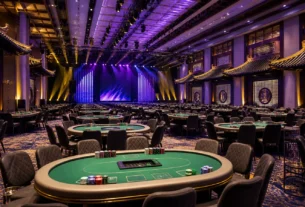
The Asian Poker Tour's Single Day High Roller – Mystery Bounty was building a substantial field at Paradise City on August 11, with 106 entries and a KRW320 million prize pool shown on the official event page during late registration. The KRW3.5 million event began at 4:00 p.m. Korea Standard Time, with registration scheduled to close at 8:10 p.m.
The count was already close to the 112-entry historical average cited by the tour for this format and left the Korean attendance record of 148 entries within reach. Because re-entry remained available until registration closed, both the final field and prize pool were still provisional at the time of publication and should not be treated as completed results.
How the KRW3.5 Million Buy-In Is Divided
The official structure lists KRW3.15 million from each buy-in for the prize pool and a KRW350,000 entry fee. After the staff charge, KRW1.5 million from every buy-in is allocated to the mystery bounty pool. That split makes eliminations a material part of the event's economics rather than a small side award attached to an otherwise conventional high roller.
Players therefore compete across two connected value streams: the normal finishing-position payouts and randomly determined bounties collected through eliminations. A participant can earn bounty value before reaching the deepest places, while a finalist can still finish with a different overall return from another player who receives a similar conventional payout. The randomness is central to the format's appeal and its variance.
A Fast Structure Raises the Pressure
Event #51 uses 20-minute levels and a 100,000-chip starting stack. The blinds began at 200-400 with a 400 big-blind ante and rise throughout the single-day schedule. Registration closes after Level 11, according to the published structure. The pace gives players meaningful starting depth, but it compresses decision time more quickly than a multi-day high roller with longer levels.
APT also uses a big-blind ante, with the big blind paid before the ante, and applies shot clocks to qualifying high roller events. These mechanics keep play moving and reduce avoidable delays. They also increase the importance of arrival time, stack management and familiarity with the tournament procedure, particularly for players entering during the later registration levels.

When Mystery Bounties Enter Play
The bounty phase does not begin immediately. Under the listed mechanics, mystery bounties are introduced once the field has been reduced to twice the number of paid places. Players who eliminate an opponent then redeem the bounty through a random draw. If multiple players make the same winning hand to eliminate an opponent, the associated bounty is divided between them.
That timing separates early survival from the later knockout phase. Before bounties activate, eliminations affect table balance and stack distribution but do not generate a draw. Once they are live, covering an opponent can carry additional value, and short-stack decisions can influence more than the regular payout ladder. The format rewards careful calculation while preserving an intentionally unpredictable prize element.

Early Seating and Re-Entry Rules Matter
APT offers an early-seating chip bonus: 20% for players checked in before the event begins, 15% during Level 1 and 10% during Level 2. The first 16 qualifying players can also receive 50% cash back on the tournament fee when the event begins on time. Those incentives make punctual participation economically different from entering later with the same nominal buy-in.
Players may forfeit an existing stack and re-enter before registration closes. That option can increase the final entry count beyond the number of unique participants, a distinction that matters when comparing attendance. The published figure should therefore be described as entries, not individual players, unless the tour separately reports a unique-player total after registration.
The Korean Record Remains the Main Benchmark
The tour identifies 148 entries as the Korean record for this event, set by the previous Incheon edition won by Kannapong Thanarattrakul. With 106 entries shown during late registration, the 2026 tournament needed 43 additional entries to move beyond that mark. Reaching the historical average of roughly 112 required a much smaller increase, making that benchmark more immediately attainable.
Record comparisons should wait for the official registration close. Live pages can change as new entries and re-entries are processed, and the prize pool can increase with them. The final field will provide the clearest measure of demand for a high-cost, high-variance format within a festival that already offers several conventional and mixed-game high rollers.
Why the Event Matters to Paradise City
High roller poker adds a premium customer segment to the broader APT Incheon schedule. Participants may also use accommodation, dining and other resort services during the festival, although the event page does not quantify that spending. For Paradise City, the tournament's value is therefore not limited to the chips placed on the poker table or the published prize pool.
The resort setting also reduces logistical friction for international players by combining tournament space with hotel and entertainment facilities near Incheon International Airport. Those advantages can support participation, but the final entry total remains the objective measure. Claims about wider resort impact should be kept separate from verified tournament data unless the operator publishes additional figures.
How to Read the Live Prize Pool
The KRW320 million figure displayed during late registration combines the regular prize component and the event's bounty allocation under the tour's live reporting. It should not be interpreted as the amount available only through finishing positions. The final payout schedule and bounty distribution will show how the total value was divided after registration closed. Until those tables are available, presenting a single projected first prize would be unreliable.
Live reporting also creates a timing issue for news coverage. A field snapshot can be accurate when published and become outdated minutes later without having been erroneous. The appropriate editorial response is to identify the observation time and status, preserve the original publication date, and use dateModified only when replacing the snapshot with final figures. That process gives readers a transparent record instead of making the first version appear to have contained numbers that were not yet known.
The champion's final return will also depend on mystery bounties personally drawn, not just the first-place payout. A complete results update should therefore distinguish the regular cash prize, bounty winnings and combined total whenever the tour supplies all three amounts. Combining them without explanation could make comparisons with conventional high roller prizes misleading.
Bottom Line
APT Incheon's Mystery Bounty High Roller had reached 106 entries and KRW320 million during late registration, putting it near the format's historical average and within range of the 148-entry Korean record. The KRW3.5 million buy-in includes a large KRW1.5 million bounty allocation, giving knockout draws an unusually important role in the event's final distribution of value.
The numbers remained live at publication. The next definitive update should record the final entry count, final prize pool, payout schedule, largest mystery bounty and champion. Until registration closes and results are posted, 106 entries and KRW320 million are a verified snapshot rather than the tournament's completed outcome.