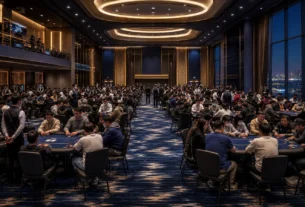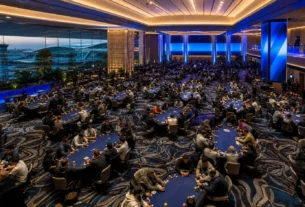

The Asian Poker Tour’s flagship Super High Roller at APT Incheon moved into its decisive stage at Paradise City on Monday with a prize pool of KRW801 million, comfortably above the tournament’s KRW500 million guarantee.
The official APT event feed recorded 58 entries in the KRW15 million buy-in tournament. Fourteen players survived the opening day, with Japan’s Reoma Ogawa returning as chip leader on 2,335,000. Taiwan’s Chih Wei Fan followed with 1,950,000, while Dutch player Michel Molenaar began the final day third on 1,620,000.
Play resumed at 11:15 a.m. Korea Standard Time, not 11:45 a.m. as appeared in some advance listings. The later time belongs to the opening flight of the separate High Roller Ultra Stack. The APT live feed subsequently showed the Super High Roller down to two players, with KRW236 million listed for first place. That status was live and subject to change until the tour posted a confirmed winner.
For Paradise City, the event is more than a large poker payout. It is a concentrated premium-traffic product that brings internationally mobile players, accompanying guests, media and spectators into an integrated resort for an extended stay.
The guarantee became a floor, not the final prize pool
APT advertised KRW500 million in guaranteed prize money for the two-day, eight-handed tournament. The final KRW801 million pool exceeded that floor by KRW301 million, or just over 60 percent.
That overage is a useful measure of demand. Guarantees can attract attention and reduce uncertainty for players, but actual entries show whether the market is willing to support the price point. A field of 58 at KRW15 million each indicates meaningful appetite for a high-cost event at this stop, even though the entry count should not be confused with 58 unique visitors because the format allowed re-entry.
The buy-in breakdown published by APT allocates KRW14.25 million from each entry to the prize pool and KRW750,000 to the entry fee. Players also contribute 3 percent from the prize pool toward staffing. The tournament winner receives an APT Championship Main Event seat in Taipei in November, valued by the tour at KRW13.93 million, in addition to the cash prize and trophy.
APT scheduled 40-minute blind levels and began the tournament with a 250,000 starting stack. The event was played eight-handed, a structure often favored in premium tournaments because it produces more frequent decisions and leaves less room for players to wait passively for the strongest starting hands.
Why high rollers matter to an integrated resort
The direct tournament economics are only part of the commercial picture for Paradise City. A premium poker customer may generate spending across hotel rooms, restaurants, bars, transport, entertainment and other resort services. A two-day event also encourages a longer visit than a single casino-floor session, especially when it sits inside a ten-day festival with other large tournaments before and after it.
Paradise City is positioned near Incheon International Airport, an important advantage for an event targeting players from Japan, China, Taiwan, Southeast Asia, Europe and other markets. Convenient international access reduces the friction around a short poker trip and helps the resort combine gaming demand with lodging and leisure spending.
CasinoWire previously reported that Paradise City casino sales and visitor traffic increased, with Japanese VIP and mass-market demand among the drivers. A marquee poker festival addresses a related objective: filling premium inventory with visitors who have already demonstrated a willingness to travel and pay a substantial entry fee for live gaming entertainment.
The relationship should not be overstated. A tournament entry does not automatically translate into a fixed amount of casino play or hotel revenue, and public event data do not disclose individual spending away from the poker tables. Still, field size, re-entry volume and the gap between a guarantee and the final prize pool provide timely indicators of destination demand.
A premium anchor inside a broader festival
APT Incheon runs from August 7 through August 16 in partnership with Paradise Group. The tour announced more than KRW4 billion in guarantees across the full schedule, giving Paradise City a succession of reasons for poker customers to arrive early or remain after a single event.
The Super High Roller is one of the clearest premium anchors. It follows early side events and overlaps with the opening stages of the KRW1.5 billion-guaranteed Main Event. On the same Monday, the KRW4.5 million High Roller Ultra Stack also began, creating a second high-cost option for players eliminated from the Super High Roller or those seeking a different structure.
That sequencing matters. A resort benefits when a festival offers multiple price points and immediate alternatives, because a player’s trip does not have to end after elimination from one tournament. Satellites, side events and cash games can extend activity, while premium events give the schedule a level of visibility that smaller tournaments rarely generate on their own.
The APT Incheon festival opened with more than KRW4 billion guaranteed, and early results already showed demand across more than one segment. The Korea National Cup drew 709 entries, while a KRW4 million Single Day High Roller attracted 45 entries. Those results suggest that the resort is drawing both larger-volume festival traffic and a smaller but commercially important premium cohort.
International reach is part of the value
The leading stacks after Day 1 illustrate the cross-border character of the event. Ogawa, Fan and Molenaar represented three different poker markets, while the wider survivor list added further international depth. That diversity strengthens the event’s value as destination marketing: coverage travels through players’ home markets, social channels and poker media even when viewers do not travel to Incheon for this edition.
APT also offered an official live stream and hand-by-hand reporting during the final day. Streaming expands the audience beyond the room and gives Paradise City repeated visual exposure as the event moves toward its champion. It does not replace physical visitation, but it can support future-trip awareness and reinforce the resort’s association with premium Asian poker.
Because the tournament was still live when this report was prepared, CasinoWire is not naming a champion before the APT confirms the result. The stable takeaway is already clear: the event surpassed its guarantee by a wide margin and delivered a substantial international high-roller field to Paradise City.
What comes next at APT Incheon
The Super High Roller concludes early in the festival rather than closing it. Main Event starting flights continue before the field combines later in the week, and the schedule includes additional high rollers, the Zodiac Classic, a Superstar Challenge and the festival-ending APT High Roller.
That makes the KRW801 million pool an early commercial signal rather than a final scorecard for the stop. Paradise City will be looking for the premium audience to remain engaged across the rest of the schedule, while APT will measure whether its Main Event and later signature tournaments can produce similar demand.
For now, the Super High Roller has done what a marquee integrated-resort event is designed to do: convert a headline guarantee into a larger real prize pool, attract international players and place premium poker at the center of the resort’s August traffic story.