
APT Incheon 2026 has become the largest and richest Asian Poker Tour festival held in mainland South Korea, closing with 14,059 entries and KRW 15,966,848,834 in total prize money. The ten-day series at Paradise City drew 2,329 unique players from 45 countries and regions across 103 trophy events and three satellites.
The final figures turn the festival into more than a collection of tournament results. They provide a measurable indicator of international event-driven traffic at one of South Korea’s most prominent integrated resorts. Compared with APT Incheon 2025, total entries rose 13.6% and prize money increased 4.4%. Since 2023, entries have more than doubled, rising 108.1%, while combined prize pools have grown 86.4%.
Those increases matter for Paradise City because tournament poker can bring guests to a resort for multiple days. Players, staff and companions may use hotel rooms, restaurants and entertainment facilities in addition to the tournament floor. Public poker figures do not reveal spending elsewhere in the resort, but the scale and duration of the festival make it a meaningful source of potential international traffic.
Main Event Sets a New Incheon Benchmark
The APT Main Event produced 1,393 entries, including 807 unique players, and a KRW 3,008,880,000 prize pool. Both figures set new mainland Korean marks for the tour. Entry volume and the prize pool were each 8.74% higher than in 2025, when the event had already established a demanding comparison.
Hong Kong’s Stephen Pang won the Main Event for KRW 411.18 million and also received a USD 10,000 seat for the APT Championship Main Event in November. The tournament’s prize pool exceeded twice its KRW 1.5 billion guarantee, showing that demand was not dependent on an organizer-funded shortfall.
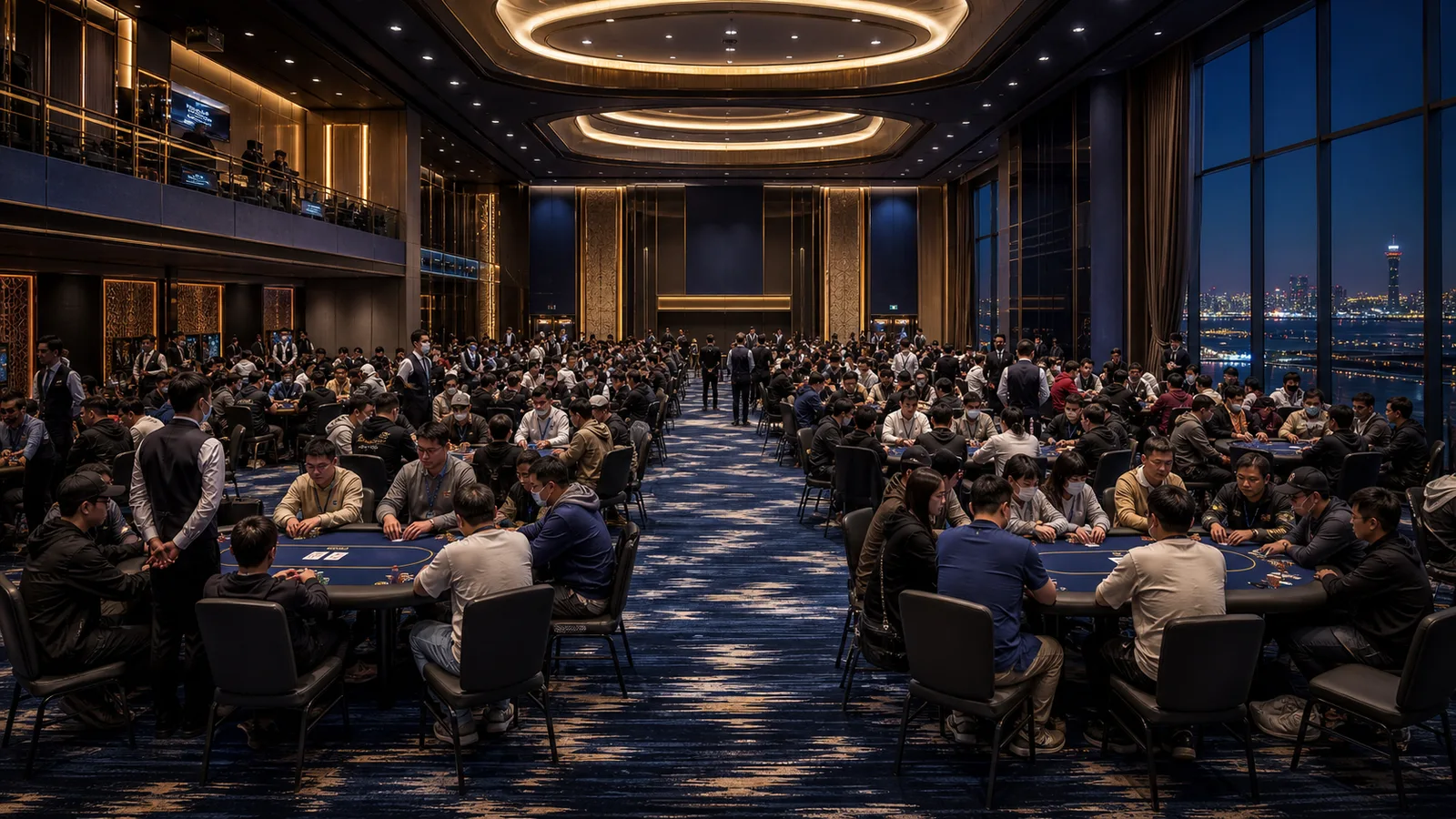
The largest field of the festival did not come from the flagship event. The Mini Main Event attracted 1,427 entries and built a KRW 1.079 billion prize pool. Together, the two four-figure fields show that player demand extended beyond a single marquee tournament. That breadth is commercially important for a resort because a full schedule gives participants reasons to arrive earlier, stay after elimination and enter events at different price levels.
APT High Roller Adds Premium Demand
The final signature trophy event underlined the premium end of the market. Japan’s Chang Hwan Lee won the KRW 5 million APT High Roller after outlasting a 222-entry field. The event generated KRW 959.04 million in prize money, approximately USD 685,000, and Lee collected KRW 199.87 million plus a USD 10,000 APT Championship Main Event seat.
The United Kingdom’s Jun Li finished second for KRW 134.57 million, while Hong Kong’s Chun Shing Lau took third for KRW 94.88 million. The final table also included players representing Russia, Germany, Malaysia and Thailand. That mix supports the view that the festival was drawing high-value customers from several regional and international markets rather than relying on a single domestic player base.
APT reported that its leading high-roller events generated several of the festival’s largest pools. The Superstar Challenge reached KRW 961.35 million, the APT High Roller reached KRW 959.04 million, the High Roller Ultra Stack produced KRW 863.14 million and the Super High Roller generated KRW 801.71 million. Premium tournaments therefore contributed materially to the record total, even though their fields were smaller than those of the major mass-participation events.
Side Events Show Demand Beyond the Headlines
The closing-day Ultra Stack supplied another sign of depth. Taiwan’s Po Hao Liao won his first APT title and a career-best KRW 65,639,878 after the event attracted 600 entries across three opening flights. The field created a KRW 339 million prize pool, with Japan’s Masayuki Suzuki finishing second and China’s Jie Zheng third.
A 600-entry side event is significant because it shows that record attendance was not concentrated solely in the Main Event, Mini Main Event or most expensive tournaments. The series was able to sustain large fields late in the schedule, when some international players might otherwise have departed after earlier eliminations.
Premium activity also remained visible on the final day. Japan’s Shunsuke Senoo won the 79-entry Last Chance High Roller for KRW 56.308 million, securing his first APT title and largest live result. Kyohei Tobita finished second for KRW 40.03 million, and Shinya Maeda completed an all-Japanese top three for KRW 26.21 million.
Thailand’s Anusorn Asiralertsiri then earned his second APT title in the 77-entry Turbo High Roller. He collected KRW 28,039,600, ahead of Hong Kong’s Sze Mei Lau and Thai star Punnat Punsri. The result added another multinational final table to a festival whose closing events featured players from Japan, Thailand, Hong Kong, Taiwan, China and other Asian markets.
Why Tournament Traffic Matters to Paradise City
Paradise City’s location near Incheon International Airport gives the resort a practical advantage when attracting players from Japan, Greater China and Southeast Asia. A dense ten-day schedule can convert that accessibility into longer stays by offering a ladder of events, from lower-cost side tournaments to signature high rollers.
That pattern fits the broader role of poker inside integrated resorts. Tournament entries are directly measurable, but the wider commercial effect can include rooms, dining, entertainment and repeat visits. Those effects should not be treated as confirmed revenue without property-level disclosures. Still, a festival with 2,329 unique players provides a much stronger traffic signal than an isolated winner result.
The increase since 2023 is especially notable. A 108.1% rise in entries over three years suggests that APT Incheon is building recurring demand, not merely benefiting from one exceptional Main Event. The 2026 edition also broke eight tour records across different competitions, including records connected to the Korea National Cup, Zodiac Classic, High Roller Ultra Stack, Women’s Event, Heads Up event and Sunday Super Stack.
Records Do Not Remove Player Risk
Large prize pools and career-best payouts can make tournament poker appear predictable, but every buy-in remains at risk. Re-entry formats can increase total spending, and published entry counts are not the same as the number of individual players. The festival’s 14,059 entries came from 2,329 unique participants, illustrating how repeat entries form a major part of tournament volume.
Players should budget for buy-ins, travel and accommodation together and should not treat tournament poker as guaranteed income. Transparent structures, accurate prize reporting and effective age and identity controls remain essential when an event draws visitors from many jurisdictions.
Bottom Line
APT Incheon 2026 finished with 14,059 entries and nearly KRW 15.97 billion in prize money, setting new festival records for mainland South Korea. The Main Event supplied a flagship benchmark, while high rollers and major side events showed that demand extended across the schedule.
For Paradise City, the most important number may be the 2,329 unique players arriving from 45 countries and regions. Their participation gives the resort a clear event-driven traffic base, even though the property has not disclosed the festival’s direct effect on casino or non-gaming revenue. With entries now more than double the 2023 level, poker is becoming an increasingly visible part of the resort’s international event calendar.