
The operator of The Venetian Resort Las Vegas has agreed to a $7.2 million settlement with Nevada gaming regulators over serious compliance failures connected to convicted illegal bookmaker Mathew Bowyer. The case raises broader questions about source-of-funds checks, the role of casino hosts, the conflict between VIP revenue and regulatory responsibility, and who bears the cost when a casino changes ownership.
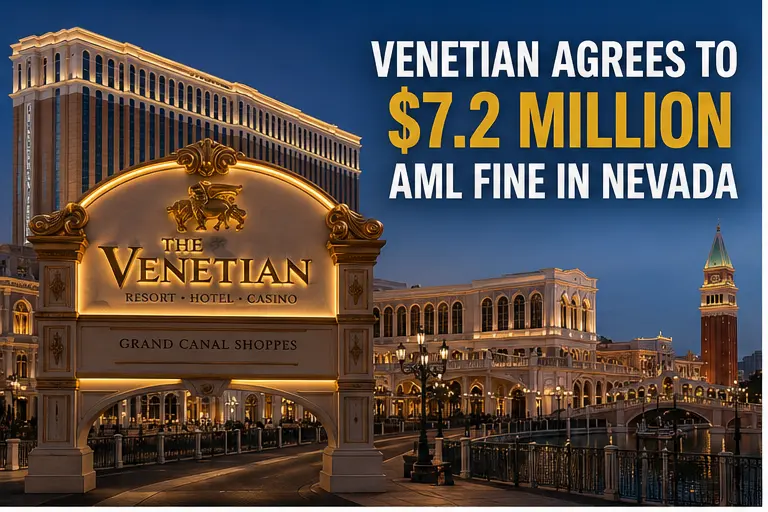
The operator of The Venetian Resort Las Vegas has agreed to pay $7.2 million to resolve a regulatory case linked to the gambling activities of Mathew Bowyer, a convicted operator of an illegal sports betting business.
The proposed settlement was signed by Venetian Las Vegas Gaming LLC and the Nevada Gaming Control Board. However, it is not yet final and must still be reviewed and approved by the Nevada Gaming Commission.
If the Commission approves the agreement, Venetian will be required to pay the penalty within two business days.
Although the financial penalty is substantial, the settlement goes far beyond a single payment. Venetian has also accepted several long-term compliance obligations involving staffing levels within its anti-money laundering department, enhanced training for casino hosts, tighter controls over independent agents, oversight of player exclusion decisions, and an independent review of its wider AML program.
Bowyer Deposited $22.3 Million and Lost at Least $3.6 Million
According to the regulatory complaint, Bowyer visited The Venetian approximately 30 times between 2019 and 2021.
During that period, he deposited around $22.3 million into his casino account, gambled at a multimillion-dollar level and lost at least $3.6 million.
His activity declined significantly after 2021. Regulators said Bowyer lost a further $137,500 in 2022, while he finished 2023 with approximately $49,000 in winnings.
Despite the concerns surrounding his financial profile, Bowyer was not formally banned from The Venetian until March 2024.
The central issue was not simply how much money Bowyer lost. Regulators focused on whether the casino had sufficient evidence showing that the funds used for gambling came from legitimate and verifiable sources.
The Nevada Gaming Control Board alleges that The Venetian possessed information over several years indicating a mismatch between Bowyer’s reported business activities, assets and level of gambling.
Despite those warning signs, regulators concluded that the casino did not take adequate steps to verify his source of wealth or restrict his activity at an earlier stage.
Reported Income Did Not Match the Available Business Records

When Bowyer attempted to resume active gambling at The Venetian in 2019, he said he was the chief executive of Green Forever, a company reportedly involved in synthetic grass installation.
He declared an annual income of between $500,000 and $1 million, a net worth of more than $5 million, real estate holdings worth approximately $3.2 million and a retirement account valued at around $200,000.
However, an internal review reportedly found that Green Forever generated no more than approximately $94,000 in annual sales.
The casino identified inconsistencies in the information but still concluded that Bowyer’s business interests and real estate holdings could support his planned casino visit, with additional verification expected to take place later.
During a visit in June 2019, Bowyer presented a cashier’s check for $1 million. Because he finished the visit with a net gambling win, the check was not deposited and was returned to him.
Over the following years, Bowyer provided the casino with different descriptions of his occupation.
At various times, he reportedly described himself as the owner of a betting and real estate investment business, the chief executive of a medical company, a professional gambler and an investor.
Regulators said The Venetian was frequently unable to verify those claims or discovered conflicting information during its checks.
Enhanced Due Diligence Raised “Significant Concern”
In 2021, The Venetian commissioned an enhanced background investigation into Bowyer through an external provider.
Enhanced due diligence is generally used for customers considered to present a higher financial crime or regulatory risk.
The investigation highlighted Bowyer’s 2011 bankruptcy, a 2012 monetary judgment in favor of another Las Vegas casino and the lack of clear public information concerning his income and financial position.
His source of wealth was reportedly classified as an area of “significant concern.”
This is one of the most important parts of the regulatory case.
The Venetian was not operating without information. The casino had access to several warning signs, including inconsistent business records, unverified income, a previous bankruptcy, multimillion-dollar gambling activity and an enhanced due diligence report questioning the source of Bowyer’s wealth.
The case therefore does not appear to involve a single missed document or isolated administrative mistake.
Regulators have presented it as a multiyear failure to connect multiple pieces of information and turn them into an effective risk assessment.
Casino Host Allegedly Knew Bowyer Was Taking Illegal Bets
One of the most serious allegations concerns a casino host responsible for maintaining the relationship between The Venetian and Bowyer.
According to the complaint, Bowyer told the employee in 2019 or early 2020 that he was “taking bets” and allegedly offered to reward the host for referring new customers to him.
The employee reportedly understood that Bowyer was operating as an illegal bookmaker and knew that the information should be reported to management or the casino’s AML department.
However, the host allegedly failed to report the conversation.
Regulators have not claimed that Venetian management approved or supported this conduct.
The filing states that the casino was not aware of the employee’s failure until September 2025 and that corrective action was taken once management learned about it.
Nevertheless, under Nevada gaming rules, a licensed casino can be held responsible for the actions and failures of its employees.
The host’s conduct therefore became one of the four counts included in the regulatory complaint.
This part of the case exposes one of the most difficult weaknesses in the VIP casino model.
Casino hosts are expected to build relationships with high-value customers, arrange benefits, maintain loyalty and encourage repeat visits.
At the same time, they are expected to act as a first line of defense when they observe suspicious activity.
When the commercial incentive to retain a valuable customer becomes stronger than the obligation to report concerns, a compliance program may exist on paper without functioning properly in practice.
Four Counts Included in the Regulatory Complaint
The Nevada Gaming Control Board filed a complaint containing four separate counts.
The first concerns the alleged failure to adequately establish the source of Bowyer’s funds.
Regulators argue that, over approximately five years, The Venetian did not conduct sufficient checks to confirm that Bowyer’s legitimate income and wealth could support the level at which he was gambling.
The second count relates to the failure to ban Bowyer in a timely manner.
According to the regulator, every day on which Bowyer was permitted to gamble after the casino host became aware that he was an illegal bookmaker may have represented a separate regulatory violation.
The third count concerns the casino host’s failure to report information about Bowyer’s illegal activities.
The fourth count relates to The Venetian’s initial failure to conduct an internal investigation following Bowyer’s exclusion and later guilty plea.
In the proposed settlement, The Venetian stated that an internal investigation was initiated shortly after Bowyer was banned in March 2024.
As part of the agreement, Venetian has accepted the allegations contained in the regulatory complaint.
However, those admissions will not become final unless the Nevada Gaming Commission approves the settlement.
What AML Compliance Means for a Casino

For the purposes of federal financial regulation, casinos in the United States are treated as financial institutions.
The Bank Secrecy Act and related rules require qualifying casinos to maintain written anti-money laundering programs, monitor large and suspicious transactions, retain records and apply risk-based controls to customers.
For high-value players, recording a deposit is not enough.
A casino must understand who the customer is, what the person does for a living, where the customer’s wealth comes from and whether the volume of transactions has a reasonable and lawful explanation.
According to the regulatory filing, The Venetian’s own internal policies required the casino to review customer identity, source of funds, business purpose, marker activity and gambling patterns.
The policies also stated that funds should not be accepted when there were doubts about their legitimacy and that suspicious circumstances should be escalated to management.
The regulatory concern was therefore not necessarily that the casino lacked written procedures.
The alleged failure involved implementation, information sharing between departments and decision-making after significant risk indicators had already appeared.
Who Pays for the Failures of a Previous Owner
Most of the activity described in the complaint took place between 2019 and 2021, when The Venetian was still operated by Las Vegas Sands.
The current operator, associated with Apollo Global Management, did not take control of the resort’s operations until February 2022.
Apollo acquired the operating business of The Venetian and Palazzo for $2.25 billion, while VICI Properties paid $4 billion for the land and real estate.
The combined transaction was valued at $6.25 billion.
However, the new operator also assumed liabilities connected to the previous period of ownership.
That means the current operator is responsible for paying the proposed fine even though most of Bowyer’s activity occurred before Apollo took control.
The regulatory filing states that the present owners accepted the relevant operational obligations when the acquisition was completed.
This sends an important message to the broader casino industry.
Acquiring a gaming operation does not mean taking over only its revenue, customer database, employees and brand value.
It can also involve inheriting its regulatory history, previous compliance weaknesses and potential future penalties.
The case illustrates why AML records and compliance procedures must form a central part of due diligence before a casino acquisition.
A failure that has not yet been formally identified at the time of purchase can become a multimillion-dollar liability several years later.
Compliance Reforms May Be More Significant Than the Fine
Under the proposed settlement, The Venetian will not simply pay $7.2 million.
Its gaming license will be subject to a series of additional compliance obligations.
The company must maintain or increase the current number of employees working in its AML department for at least two years.
Its AML policy must be reviewed at least once per year, while significant changes must be reported to the chair of the Nevada Gaming Control Board.
The vice president responsible for compliance may also be required to meet with Gaming Control Board members up to four times per year to discuss the company’s AML program and compliance with the Bank Secrecy Act.
The Venetian must also improve the way it shares information with financial institutions in situations that may involve money laundering.
Within 60 days of the settlement’s approval, the company must provide detailed training to independent agents, casino hosts, player-development employees, marketing executives and anyone authorized to approve casino credit of at least $50,000.
A licensed individual must also be assigned primary responsibility for the AML program.
That person’s responsibilities will include oversight of decisions to exclude, suspend or reinstate a customer.
The agreement also requires a campaign directed at casino-floor employees, cashiers, dealers and marketing personnel to encourage the reporting of suspicious behavior.
After two years, an independent specialist will be required to assess the program and submit findings to both The Venetian and Nevada regulators.
These measures demonstrate that regulators are not treating the case as a closed historical incident.
The objective is to change the way commercial, VIP, marketing and compliance departments communicate with one another.
Bowyer-Related Casino Penalties Reach $34 Million
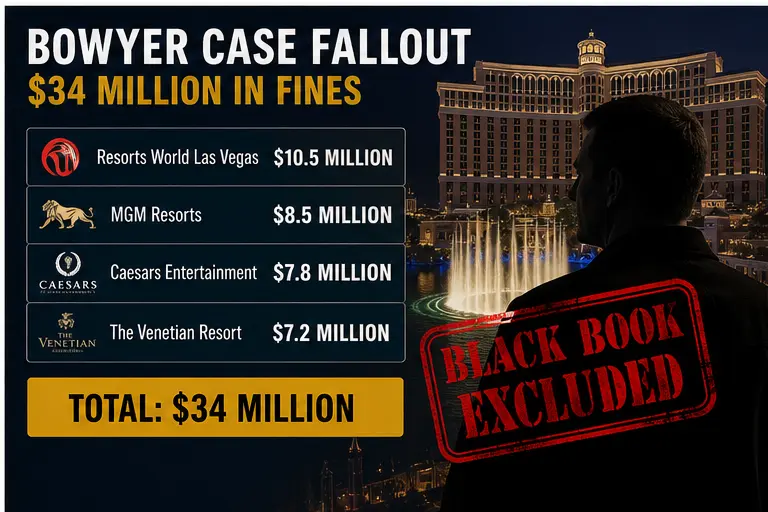
The Venetian is the fourth major casino operator to face a significant Nevada penalty over dealings connected to Bowyer.
Resorts World Las Vegas previously agreed to pay $10.5 million.
MGM Resorts accepted an $8.5 million penalty, while Caesars Entertainment agreed to pay $7.8 million.
With The Venetian’s proposed $7.2 million settlement included, the total regulatory penalties connected to Bowyer now reach approximately $34 million.
That makes Bowyer one of the most expensive individual casino customers in the recent history of Nevada gaming enforcement.
Bowyer operated an illegal gambling business for at least five years and, during certain periods, reportedly served more than 700 customers.
In August 2024, he pleaded guilty to operating an illegal gambling business, money laundering and filing a false tax return.
In August 2025, he was sentenced to one year and one day in federal prison and ordered to pay more than $1.6 million in tax restitution.
The case attracted international attention because of Bowyer’s connection to Ippei Mizuhara, the former interpreter of Major League Baseball star Shohei Ohtani.
According to the U.S. Department of Justice, Mizuhara placed at least 19,000 bets through Bowyer’s operation, accumulated net gambling losses of approximately $40.7 million and stole nearly $17 million from Ohtani’s bank accounts to pay gambling debts.
Federal authorities said that at least $9.3 million in illegal proceeds was transferred to a casino to pay gambling markers belonging to Bowyer and his associates.
Bowyer has since been added to Nevada’s list of excluded persons, commonly known as the Black Book, preventing him from entering licensed casinos in the state.
An Isolated Failure or a Wider Las Vegas Strip Problem
The fact that four major operators have been penalized suggests that the matter cannot easily be dismissed as the mistake of one employee or one casino.
Bowyer was able to gamble for enormous sums at several prestigious Las Vegas properties, even though his sources of income and wealth were not always clearly verified.
At the same time, his value as a high-stakes customer created a strong commercial incentive for casinos to continue accepting his play.
This is the central conflict highlighted by the case.
Player-development departments measure success through gambling volume, customer retention and casino revenue.
Compliance departments are expected to restrict or reject the same customers when financial or regulatory risks become too high.
When Bowyer lost millions of dollars, the casinos generated direct gambling revenue.
Once his operation was exposed as illegal, those same revenues became evidence that existing controls may not have functioned as intended.
Nevada Gaming Control Board Chairman Mike Dreitzer has described the regulator’s current approach with the phrase “compliance over commerce.”
The message is that customer value cannot be allowed to outweigh regulatory obligations.
Nevada Has Tightened AML Rules
The enforcement actions involving Resorts World, MGM Resorts, Caesars and The Venetian have already influenced Nevada’s wider regulatory framework.
In April 2026, the Nevada Gaming Commission approved new rules intended to increase individual accountability for casino AML programs.
Senior compliance executives and certain player-development personnel may now be required to undergo additional regulatory review and hold specific licenses or registrations.
The rules also introduce tighter controls for independent agents.
Casinos may be permitted to withhold compensation from agents when the legitimate source of a referred customer’s funds cannot be established.
Operators may also be required to report employees dismissed for violating AML rules.
For casino companies, the implication is clear.
AML compliance can no longer operate as an isolated responsibility belonging only to one department.
Responsibility extends to casino hosts, marketing employees, player-development teams, credit departments and senior management.
Previous AML Issues Connected to The Venetian
This is not the first time that operations associated with The Venetian have faced scrutiny over the handling of suspicious financial activity.
In 2013, Las Vegas Sands reached an agreement with federal prosecutors and forfeited approximately $47.4 million in a case involving failures to properly report suspicious activity.
In 2016, the Nevada Gaming Commission approved a further $2 million settlement connected to those events.
Although the current operator is different from the company that controlled the resort during those earlier incidents, the regulatory history of the property adds significance to the latest case.
It shows that questions involving source-of-funds checks and the treatment of high-value players have appeared across different periods of ownership.
The Reputational Risk May Exceed the Financial Penalty
The immediate financial cost to The Venetian is $7.2 million.
However, the longer-term consequences may involve brand reputation, increased regulatory oversight and the expense of implementing new controls.
Independent reviews, additional employees, mandatory training and regular meetings with regulators may produce significant costs over several years.
More importantly, any future compliance failure could be evaluated in the context of this settlement and the warning signs already identified.
For the wider casino industry, the message is straightforward.
VIP status does not reduce the need for due diligence. It increases it.
The larger the deposits, losses and gambling volume, the stronger the evidence a casino should require to confirm that the customer’s financial profile supports that activity.
What Happens Next
The Nevada Gaming Commission must decide whether to approve the settlement between The Venetian and the Gaming Control Board.
Until that decision is made, the $7.2 million penalty has been agreed upon but is not yet final.
If the agreement is approved, The Venetian will pay the fine and begin implementing the required reforms within the deadlines set by the settlement.
The Commission can approve or reject the agreement. If it is rejected, the formal admissions contained in the settlement would also be withdrawn.
Regardless of the Commission’s final decision, the Mathew Bowyer case has already changed the way Nevada regulators approach anti-money laundering controls in casinos.
One illegal bookmaker exposed similar weaknesses at several of the largest operators on the Las Vegas Strip, generated approximately $34 million in regulatory penalties and accelerated the introduction of stricter compliance rules across the industry.
The most important consequence may therefore not be The Venetian’s financial penalty alone.
The wider impact is a shift in the balance between VIP revenue and regulatory responsibility.
For Nevada casinos, the period in which a customer’s large losses could outweigh unresolved questions about the source of their money appears to be coming to an end.