
The Ohio Casino Control Commission (OCCC) has proposed removing credit cards from the list of approved payment methods for sports betting accounts, a move that could reshape how Ohio players fund online sportsbook balances.

Proposal and Public Comment
The OCCC announced on July 7, 2026, a proposal to amend Rule 3775-16-03 by removing credit cards as an approved funding method for sports betting accounts.
According to the official notice, the rule governs the opening and funding of sports gaming accounts. The proposed change would amend paragraphs (E)(1) and (E)(7), removing credit cards from the list of accepted payment methods.
The Commission also noted that the public comment period is open until July 17, 2026. Interested parties can submit comments by email to rulecomments@casinocontrol.ohio.gov.
A Wider U.S. Trend
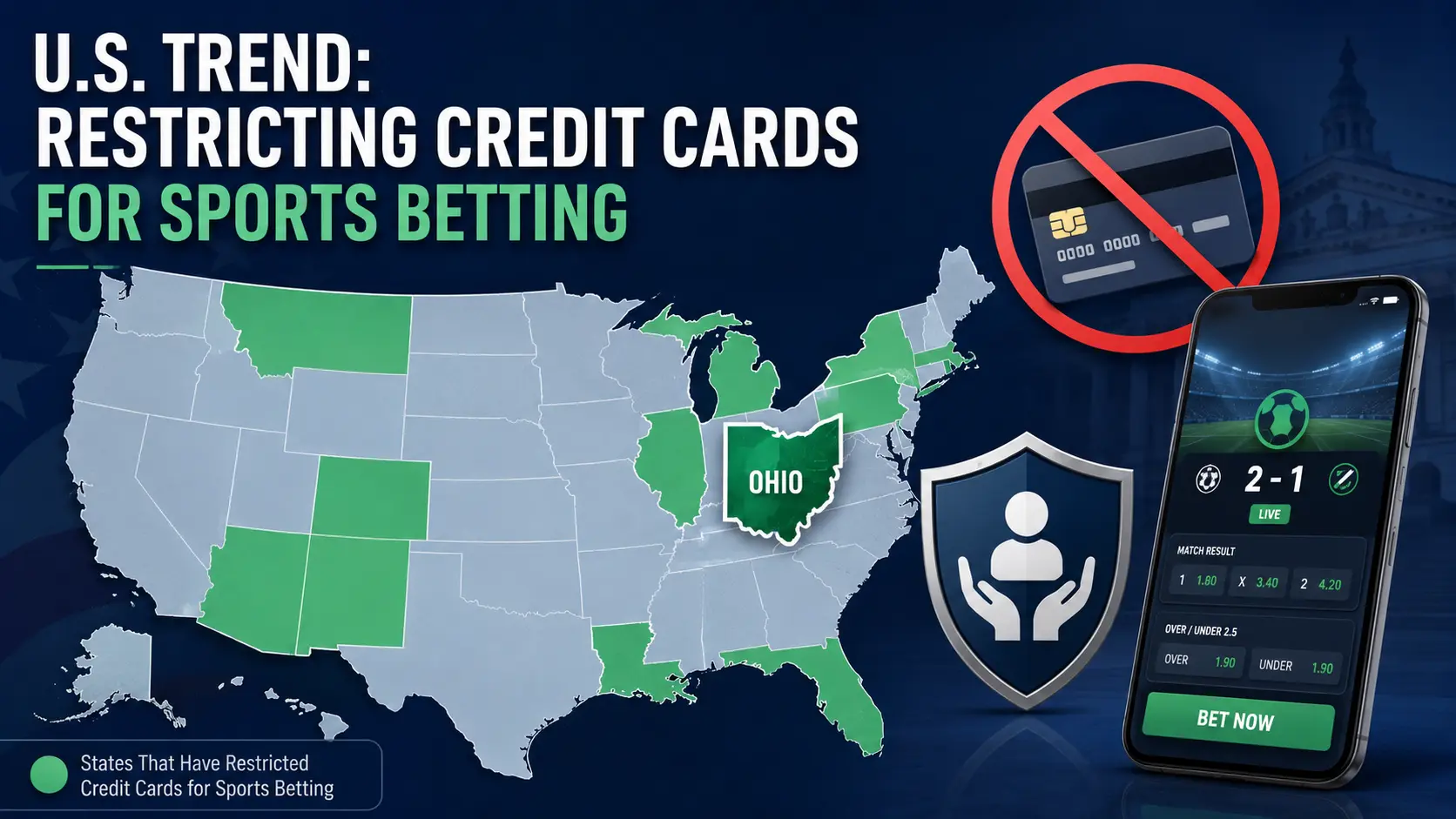
This is not an isolated move. A growing number of U.S. states are restricting or banning the use of credit cards to fund sports betting accounts, arguing that such measures protect consumers and help prevent gambling with borrowed money.
Research shows that more than 75% of problem gamblers in Great Britain have used savings or borrowed money to gamble, while the Maryland Center of Excellence on Problem Gambling reports that more than 90% of people with gambling problems use credit cards to gamble.
In Great Britain, credit card gambling was banned in 2020 after a survey found that 38% of problem gamblers had used credit cards to fund gambling activity.
Why Regulators Are Acting
Regulators point to several reasons for this shift.
- Consumer protection: The main goal is to reduce risks linked to betting with borrowed money. Mental health experts warn that gambling with money players do not actually have can deepen debt and worsen mental health issues.
- Responsible gambling: The Illinois Gaming Board has previously said that limiting credit card funding can support responsible gambling and reduce the risk of compulsive gambling behavior.
- Avoiding extra costs: Senator Elizabeth Warren has noted that operators themselves have cited reasons such as improving the deposit experience, helping customers avoid cash advance fees and high interest rates, and aligning with evolving industry standards.
- Reducing regulatory risk: DraftKings paid a $450,000 fine in Massachusetts in 2025 after improperly accepting credit card deposits. Following that, the company removed credit cards as a payment method on August 25, 2025. Removing credit cards also helps operators reduce costs linked to payment processing and chargeback disputes.
Operators Are Already Reacting

The industry has already moved toward alternative payment methods. DraftKings, FanDuel, BetMGM, bet365 and Caesars all phased out credit cards as a deposit option during 2025 and 2026.
Caesars announced on May 4, 2026, that it had removed credit cards across its U.S. digital platforms, including Caesars Sportsbook and World Series of Poker Online. The company said the move was intended to simplify the deposit process and improve operational efficiency.
FanDuel removed credit card deposits on March 2, 2026. BetMGM began phasing them out later in March, while bet365 ended credit card deposits across the U.S. on April 13, 2026.
These operator decisions follow bans in at least eight U.S. states. Tennessee, Iowa, New Hampshire, Oregon, Rhode Island, Vermont, Massachusetts and Illinois already have rules that prohibit credit card deposits for online betting.
Virginia and Maine passed similar laws in April 2026, while states such as Colorado, Maryland, New Jersey and New York have considered similar proposals. According to Senator Warren, around 80% of the U.S. sports betting market already no longer accepts credit card transactions.
Impact on Players and the Market

For players in Ohio, the proposal means they may soon be able to fund accounts only through debit cards, bank transfers, e-wallets or other approved payment methods.
This could make impulsive betting more difficult and reduce the extra costs that banks often apply to gambling transactions made with credit cards, such as cash advance fees.
However, experts warn that bans are not a complete solution. Research from the United Kingdom suggests that some high-risk players, after the credit card ban, turned to alternative sources of borrowing such as loans or overdrafts.
From a market perspective, removing credit cards is unlikely to significantly reduce operator revenue. The OCCC’s own analysis states that the industry has already largely moved away from credit cards and that the proposed rule simply aligns Ohio with the direction the market is already taking.
Still, the ban could increase compliance costs for smaller operators and require changes to payment systems and user interfaces.
Conclusion
The OCCC proposal to ban credit cards for funding sports betting accounts is part of a broader wave of U.S. gambling regulation focused on responsible betting and consumer protection.
With major operators already taking similar steps and more states introducing legal restrictions, Ohio’s public comment process may pass without major resistance from the industry.
The key question now is whether this measure will genuinely reduce gambling harm or simply push high-risk players toward other forms of borrowing.