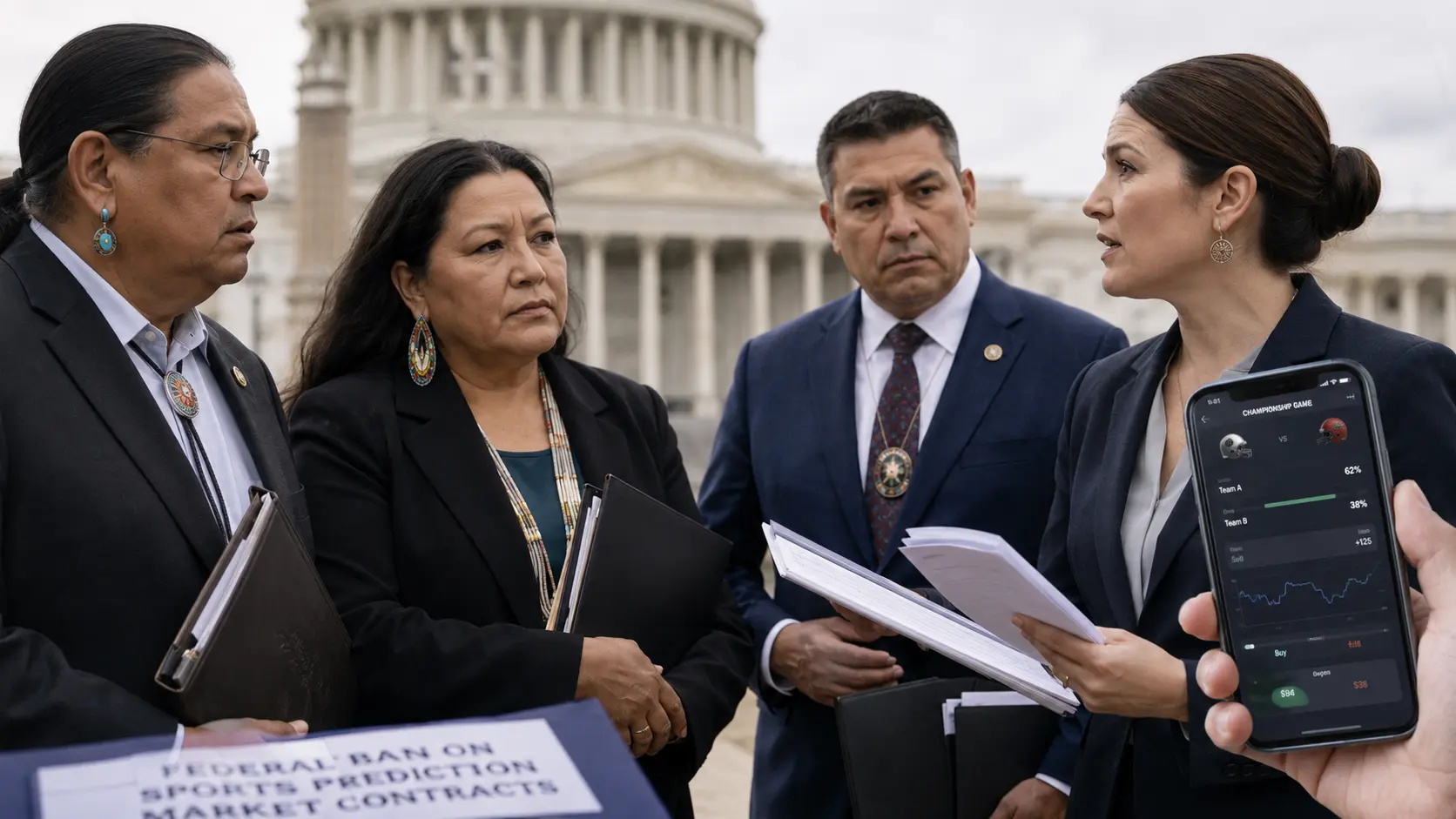
The Indian Gaming Association is increasing pressure on federal lawmakers to restrict sports and casino-style contracts offered by prediction market platforms, arguing that the rapidly growing sector threatens tribal sovereignty, state gaming authority and the regulatory framework governing gambling across the United States.
During its 2026 Summer Legislative Summit in Washington, D.C., the association brought tribal leaders to Capitol Hill for meetings with senators and congressional staff. Their central request is for the Senate to amend the CLARITY Act so that federally regulated prediction markets cannot offer contracts based on sporting events or casino-style outcomes.
The association also wants Congress to confirm that the legislation does not override the Indian Gaming Regulatory Act, tribal-state gaming compacts or existing state and federal gambling laws.
Why the CLARITY Act Has Become Part of the Gambling Debate
The CLARITY Act was primarily designed as digital asset market-structure legislation rather than a gambling bill. Its broader purpose is to establish clearer boundaries between the Securities and Exchange Commission and the Commodity Futures Trading Commission when regulating digital assets and digital commodities.
Supporters say the legislation would replace fragmented oversight with clearer rules for exchanges, brokers, dealers and other companies operating in the US digital asset market. The proposed framework would divide responsibilities between the SEC and CFTC while introducing registration, disclosure and anti-fraud requirements.
However, the Indian Gaming Association is concerned that prediction market operators using cryptocurrencies or digital commodities could benefit from the legislation unless Congress draws an explicit line between financial trading and gambling.
The organization is therefore not opposing the entire CLARITY Act. Instead, it is asking lawmakers to add provisions that would prevent the bill from becoming an indirect route for nationwide sports betting or casino-style gambling outside established gaming laws.
The House of Representatives approved an earlier version of the CLARITY Act by a 294–134 vote in July 2025. The legislation is now under consideration in the Senate, where amendments could significantly change its final scope.
Tribal Leaders Say Prediction Markets Undermine Gaming Compacts
At the center of the dispute are tribal-state gaming compacts.
Under the Indian Gaming Regulatory Act, federally recognized tribes can negotiate agreements with states covering casino gaming, sports betting and revenue sharing. In some states, tribes receive exclusive or partially exclusive rights to operate certain forms of gambling. In return, tribal governments may share revenue with the state and comply with detailed licensing, integrity and consumer-protection requirements.
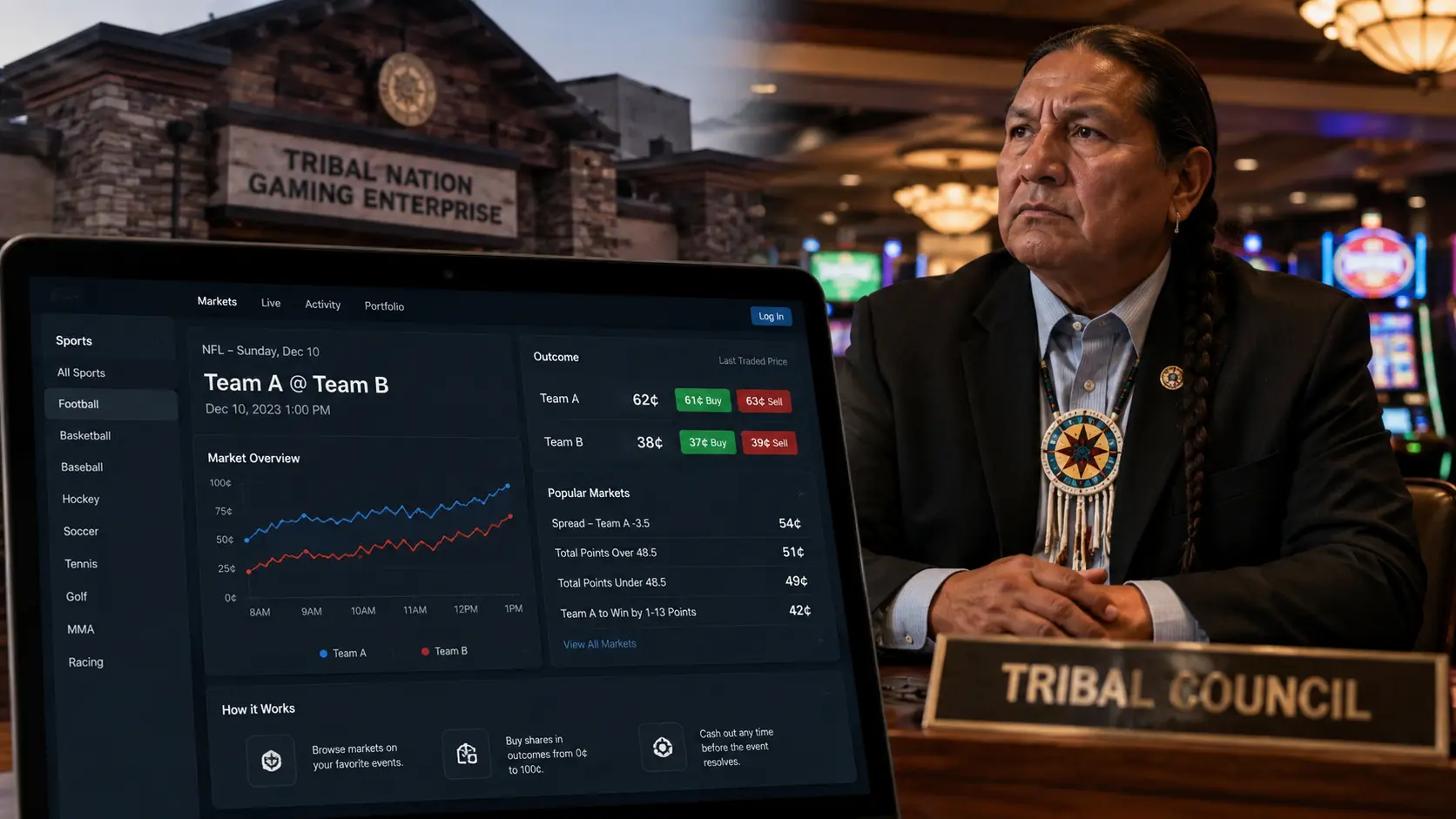
Prediction market platforms generally operate under federal commodities law. They allow customers to buy and sell contracts based on whether a particular event will occur, including the outcome of a football game, basketball tournament or other sporting competition.
Tribal leaders argue that when those contracts function like traditional bets, offering them nationally under CFTC oversight bypasses the agreements tribes spent decades negotiating with state governments.
The Indian Gaming Association says this creates an uneven market. Tribal casinos and sportsbooks must follow tribal, state and federal gaming rules, while prediction platforms may offer similar products without obtaining the same licenses, paying the same gaming taxes or honoring tribal exclusivity provisions.
The association describes the issue as one of the most serious threats tribal government gaming has faced in a generation.
More Than Casino Revenue Is at Stake
Tribal gaming revenue does not operate in the same way as ordinary corporate casino profit.
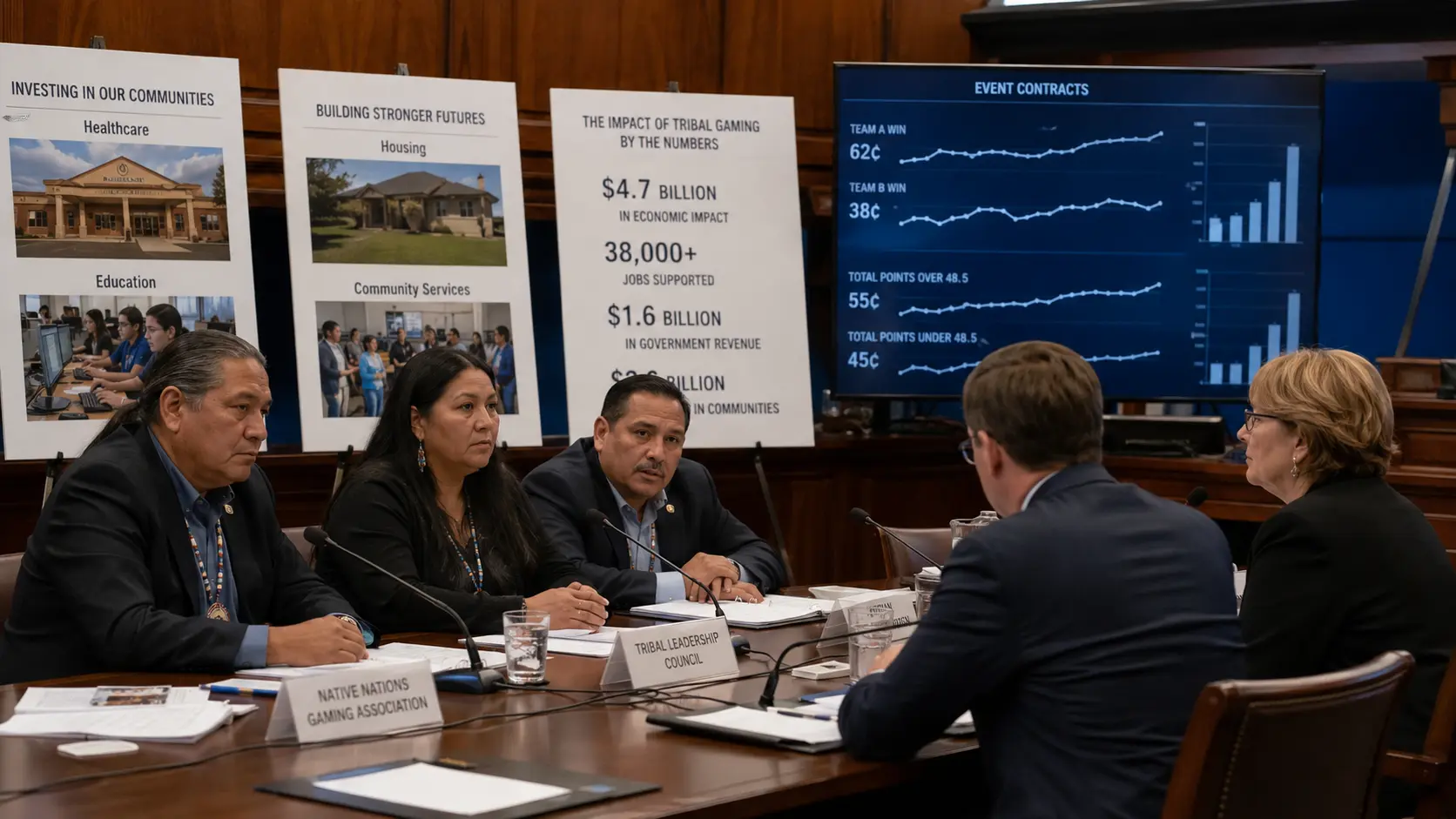
For many tribal governments, gaming income is an important source of funding for healthcare, education, housing, public safety, infrastructure, language preservation and basic government operations. Tribes generally have more limited taxation options than state and local governments, making commercial enterprises particularly important to their financial independence.
Tribal gaming generated almost $44 billion in gross gaming revenue during 2024. However, fewer than half of the 576 federally recognized tribes operate gaming businesses, and many smaller or rural tribal casinos generate only enough revenue to support essential government programs.
The Indian Gaming Association argues that nationwide sports prediction contracts could reduce revenue for regulated tribal operators while weakening the exclusivity protections on which many tribal-state agreements are based.
The financial impact has not yet been fully measured, but tribal organizations are supporting lawsuits, legislative campaigns and regulatory challenges intended to clarify where prediction markets fit within US gambling law.
Prediction Market Platforms Reject the Gambling Label
Prediction market operators strongly dispute the casino industry’s interpretation.
Platforms such as Kalshi and Polymarket maintain that their users trade financial event contracts rather than place bets against a sportsbook. Under their model, participants generally buy and sell positions against other market participants, with prices reflecting the market’s estimated probability of an outcome.
The companies argue that this structure is fundamentally different from a traditional sportsbook, where an operator establishes odds, accepts wagers and manages its own risk.
Prediction market supporters also say federally regulated exchanges can provide nationally consistent oversight, transparent pricing and information that may be useful to broadcasters, sponsors, analysts and other businesses.
The CFTC has similarly suggested that certain sports contracts may serve a price-discovery function. Its proposed approach would allow markets involving final scores, tournament advancement and player or team performance while restricting contracts tied to individual plays, injuries, officiating decisions and high school sports. Pure games of chance such as roulette would remain prohibited under the proposal, although some skill-influenced competitions could receive different treatment.
From the platforms’ perspective, banning sports contracts would protect incumbent casinos and sportsbooks from a new form of competition rather than protect consumers.
Is a Sports Event Contract a Trade or a Bet?
The central legal question is relatively simple to state but difficult to resolve: when a customer risks money on the outcome of a sporting event, is the transaction a financial derivative or a gambling wager?
That classification determines which regulator has authority.
Prediction market operators argue that event contracts listed on federally registered exchanges fall under the Commodity Exchange Act and the exclusive jurisdiction of the CFTC.
States, tribes and traditional gaming regulators counter that sports contracts are functionally indistinguishable from sports bets and should remain subject to state gambling laws, tribal compacts, licensing requirements and gaming taxes.
As of early 2026, more than 20 lawsuits and regulatory actions involving prediction markets were pending across the United States. A coalition of 38 states had also supported Maryland’s position in litigation over state regulatory authority.
Four tribal nations have separately pursued legal action against prediction market businesses, alleging violations of federal law and tribal-state agreements. The platforms deny those allegations and maintain that they operate financial markets rather than casinos or sportsbooks.
The conflicting interpretations make further federal litigation likely. Unless Congress provides a clear answer, the question of federal preemption and state gaming authority could eventually reach the US Supreme Court.
Consumer Protection and Responsible Gambling Questions
The dispute also extends beyond sovereignty and market competition.
State-licensed sportsbooks are normally required to implement minimum-age controls, identity verification, responsible gambling tools, self-exclusion programs, advertising restrictions and procedures for resolving customer disputes.
Prediction markets face federal financial-market requirements, but those rules were not originally designed as a complete framework for sports gambling. Standards covering deposit limits, gambling addiction warnings, player exclusions and advertising can therefore differ from those imposed on licensed sportsbooks.
State lawmakers are also concerned about lost tax revenue. When a sports transaction is classified as a federally regulated derivative instead of gambling, states may have limited power to license or tax it as sports betting.
The National Conference of State Legislatures has identified consumer protection, tax revenue, sports integrity and tribal compact obligations as four of the most important policy questions raised by prediction markets.
Prediction market companies respond that federal regulation still includes market surveillance, anti-manipulation rules and customer protections. They argue that Congress should improve the federal framework rather than prohibit an emerging industry.
Why the Proposed Amendment Could Have Wide Consequences
The amendment sought by the Indian Gaming Association could produce several major outcomes.
A broad prohibition would prevent federally regulated exchanges from offering sports and casino-style contracts nationwide, preserving sports betting as an activity controlled primarily by states and tribal governments.
A narrower amendment could allow some prediction contracts while explicitly preserving the authority of state regulators, tribal governments and the Indian Gaming Regulatory Act.
Congress could also decide not to address prediction markets in the CLARITY Act, leaving the issue to the CFTC, state enforcement actions and federal courts.
Each option carries different consequences. A ban would protect existing gaming frameworks but limit prediction market expansion. A federal authorization model could encourage innovation and national access but weaken state licensing systems and tribal exclusivity. A compromise would require lawmakers to define which event contracts have a legitimate financial purpose and which are effectively gambling products.
What Happens Next?
The Indian Gaming Association’s lobbying campaign will focus on senators as negotiations over the CLARITY Act continue.
Tribal leaders are asking for two core protections: a prohibition covering sports and casino-style prediction market gambling, and language confirming that digital asset legislation cannot preempt tribal, state or federal gaming laws.
The outcome will matter far beyond tribal casinos. It could determine whether sports prediction markets become a federally regulated national alternative to sportsbooks or remain subject to the same state-by-state system that governs most US gambling.
For tribal governments, the debate is ultimately about more than competition between gaming products. It concerns whether new financial technology can operate around agreements that support tribal self-government and essential public services.
For prediction market companies, it is a test of whether event contracts will be recognized as a distinct financial product capable of operating under a national regulatory framework.
Congress must now decide where financial innovation ends and gambling regulation begins.