

Pennsylvania lawmakers are facing growing pressure to introduce stricter controls for online casinos as the state attempts to balance player protection with the financial benefits generated by the country’s largest regulated iGaming market.
A new report from Pennsylvania’s bipartisan Joint State Government Commission recommends major changes to the way online gambling platforms operate. The proposals include banning credit card deposits, requiring players to set personal gambling limits and introducing tighter restrictions on casino advertising.
The report presents lawmakers with a difficult choice: introduce broad protections quickly and risk reducing gambling revenue, or continue studying player behavior before implementing more targeted measures.
Credit Card Deposits Could Be Prohibited
One of the most significant recommendations is a statewide ban on using credit cards to fund online casino accounts.
Unlike debit cards and bank transfers, credit cards allow players to gamble with borrowed money. Supporters of the proposed restriction argue that this can make it easier for players to accumulate debt, particularly during long or emotionally driven gambling sessions.
The proposed policy would bring online gambling rules closer to those applied at Pennsylvania’s land-based casinos, where operators are already prohibited from directly accepting credit cards for gambling transactions. The Joint State Government Commission identified a credit card ban as one of the measures that could be introduced relatively quickly.
State Senator Wayne Fontana has also supported legislation that would prevent online casinos from accepting credit card deposits. The new report could provide additional momentum for that proposal when Pennsylvania lawmakers return to gambling legislation.
For operators, the effect would depend on how frequently Pennsylvania players currently use credit cards. Casinos may need to promote alternative payment options such as debit cards, online banking and digital wallets.
Mandatory Player Limits Would Change the Current System
The report also recommends requiring players to establish limits before gambling.
Under such a system, customers could be required to decide in advance how much money they are prepared to lose or how much time they are willing to spend playing. This would represent an important change from systems where responsible gambling tools are available but remain optional.
Mandatory limit-setting could include:
- Daily, weekly or monthly deposit limits
- Maximum loss limits
- Restrictions on the length of individual gambling sessions
- Temporary account suspension options
The central argument is that limits are more effective when selected before a player enters a high-intensity gambling session. Once a person begins chasing losses or making impulsive decisions, voluntarily activating a limit may become less likely.
However, the report’s recommendation should not be confused with the Pennsylvania Gaming Control Board’s separate proposed regulations. The board’s current proposal would require operators to provide expanded self-limitation tools, but those limits would still generally be selected voluntarily by players.
Turning voluntary tools into mandatory requirements would probably require additional legislative action.
Online Gambling Is Increasingly Treated as a Public Health Issue
The debate is no longer focused only on individual responsibility.
Mental health and addiction specialists are urging Pennsylvania to treat gambling disorder as a broader public health challenge. The state report cites research connecting severe gambling problems with debt, family conflict, emotional distress and suicide risk.
According to reporting based on Pennsylvania research, residents of the state may be at least twice as likely to experience gambling addiction as the national population. More than one-quarter of Pennsylvania residents may also be considered at risk of developing gambling-related problems.
The accessibility of online casinos is central to these concerns. Players no longer need to travel to a physical casino, withdraw cash or interact with casino employees. Slots, table games and live dealer products are available through mobile devices at almost any time.
This accessibility has helped regulated iGaming grow rapidly, but it has also made it more difficult to create natural breaks between gambling sessions.
Advertising Rules Could Become Much Stricter
Casino marketing is another major part of the proposed reforms.
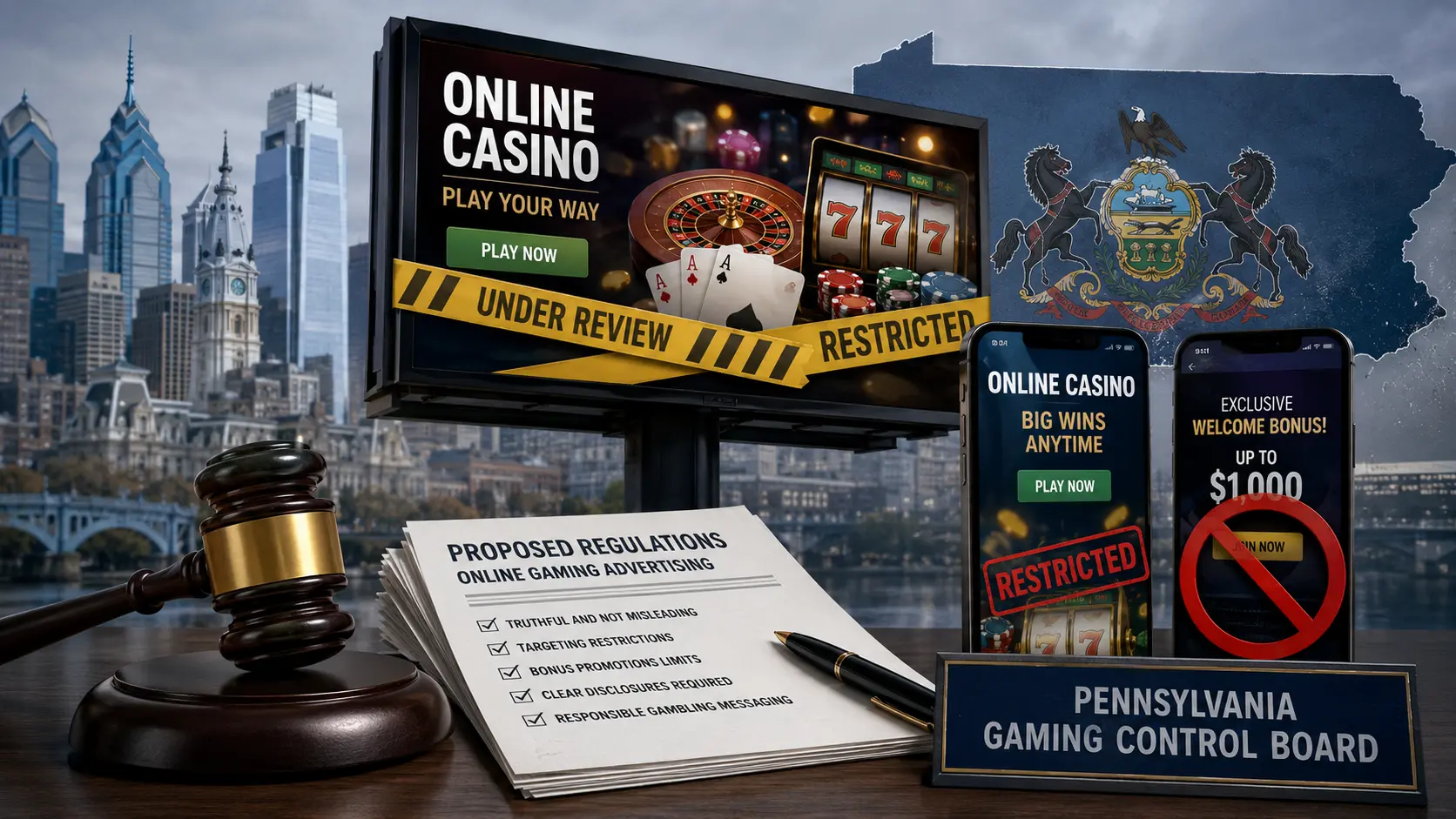
The Pennsylvania Gaming Control Board has already published proposed rules that would require licensed operators to use reasonable measures to reduce advertising exposure among people under 21. Operators would also need to provide Pennsylvania residents with a way to opt out of direct gambling marketing.
Additional recommendations discussed in the state report and proposed regulatory framework include:
- Restricting excessive saturation of gambling advertisements
- Preventing marketing to self-excluded players
- Limiting advertising where children make up a large part of the audience
- Stopping direct marketing shortly after a player opts out
- Banning misleading “free” or “risk-free” promotional claims
- Restricting AI-generated promotions
- Limiting certain VIP and personalized reward programs
The proposed rules would also prevent operators from resuming marketing to formerly self-excluded players unless those individuals first re-establish contact with the casino.
These restrictions could have a substantial effect on acquisition campaigns, bonus language, push notifications, emails and personalized promotions used by online casino operators.
VIP Programs Face Additional Scrutiny
The report specifically raises concerns about VIP programs that provide individual account managers, bonuses, gifts and personalized incentives to high-value players.
Critics argue that VIP systems may encourage customers to continue gambling after significant losses. The concern becomes more serious when operators use detailed behavioral information to identify players who are likely to deposit or wager additional money.
Restricting VIP programs would force casinos to reconsider how they define high-value customers and when personalized offers can be sent.
A complete ban is not guaranteed. Pennsylvania could instead introduce affordability checks, enhanced monitoring or restrictions preventing VIP incentives from being offered to players displaying indicators of harmful gambling.
Pennsylvania’s Revenue Creates a Regulatory Dilemma
Pennsylvania has more at stake than most states.
The state generated approximately $3.46 billion in iGaming revenue during 2025, an increase of nearly 28% from the previous year. It remained the largest regulated online casino market in the United States, while Pennsylvania, Michigan and New Jersey together accounted for nearly 90% of national iGaming revenue.
Pennsylvania’s total commercial gambling revenue reached approximately $7.7 billion in 2025 when land-based casinos, online casinos and other regulated gambling verticals were combined.
This creates an unavoidable conflict for policymakers.
Stricter limits may reduce gambling activity and therefore lower tax revenue. At the same time, delaying reforms could increase the financial and social costs associated with gambling disorder.
The state report acknowledges the economic value of regulated gambling but argues that Pennsylvania lacks sufficient data about its wider social costs.
Operators Could Face New Data-Reporting Requirements
One longer-term proposal would require operators to provide anonymized player information to an independent research organization.
The data could include:
- Player age and gender
- Geographic region
- Frequency and duration of play
- Speed of play
- Amounts wagered
- Use of responsible gambling tools
Researchers could use this information to identify behavioral patterns associated with gambling harm and develop more precise intervention systems.
Separately, the Gaming Control Board’s proposed regulations would require operators to submit periodic reports covering the use of responsible gambling tools, self-exclusion activity and accounts closed because of gambling-related concerns.
These requirements could eventually lead to automated interventions when a player suddenly increases deposits, extends playing sessions or repeatedly reverses withdrawal requests.
Could Pennsylvania Influence Other US States?
Pennsylvania’s decision could have national consequences.
Only a limited number of US states currently allow full online casino gaming. Because Pennsylvania is the largest of these markets, its regulatory model is closely watched by lawmakers, regulators and operators elsewhere.
A credit card ban, mandatory player limits or strict controls on personalized marketing could therefore become a reference point for other states considering iGaming expansion.
The proposals may also affect legalization debates. States evaluating online casino legislation could decide to include stronger responsible gambling rules from the beginning rather than attempting to add them after the market has already expanded.
What Happens Next?
The recommendations are not yet final laws.
Some changes, including a credit card prohibition and mandatory player limits, would likely require approval from the Pennsylvania legislature. Other measures could be implemented through regulations issued by the Pennsylvania Gaming Control Board.
The board’s proposed responsible gambling rulemaking was published in the Pennsylvania Bulletin on July 11, 2026. It will become effective only after the regulatory review and final publication process has been completed. A 30-day public comment period is also available following publication.
The coming debate will determine whether Pennsylvania prioritizes immediate safeguards or adopts a slower, data-driven approach designed to protect players while minimizing disruption to the regulated market.
Either way, the report signals that Pennsylvania’s online casino rules are entering a new phase. The state is no longer debating whether online gambling should be regulated, but how far regulation should go to address the risks created by a rapidly growing digital casino market.
Tagged: USA Casino News, Pennsylvania Casino News, Online Casino Regulation, Responsible Gambling, Casino Credit Card Ban