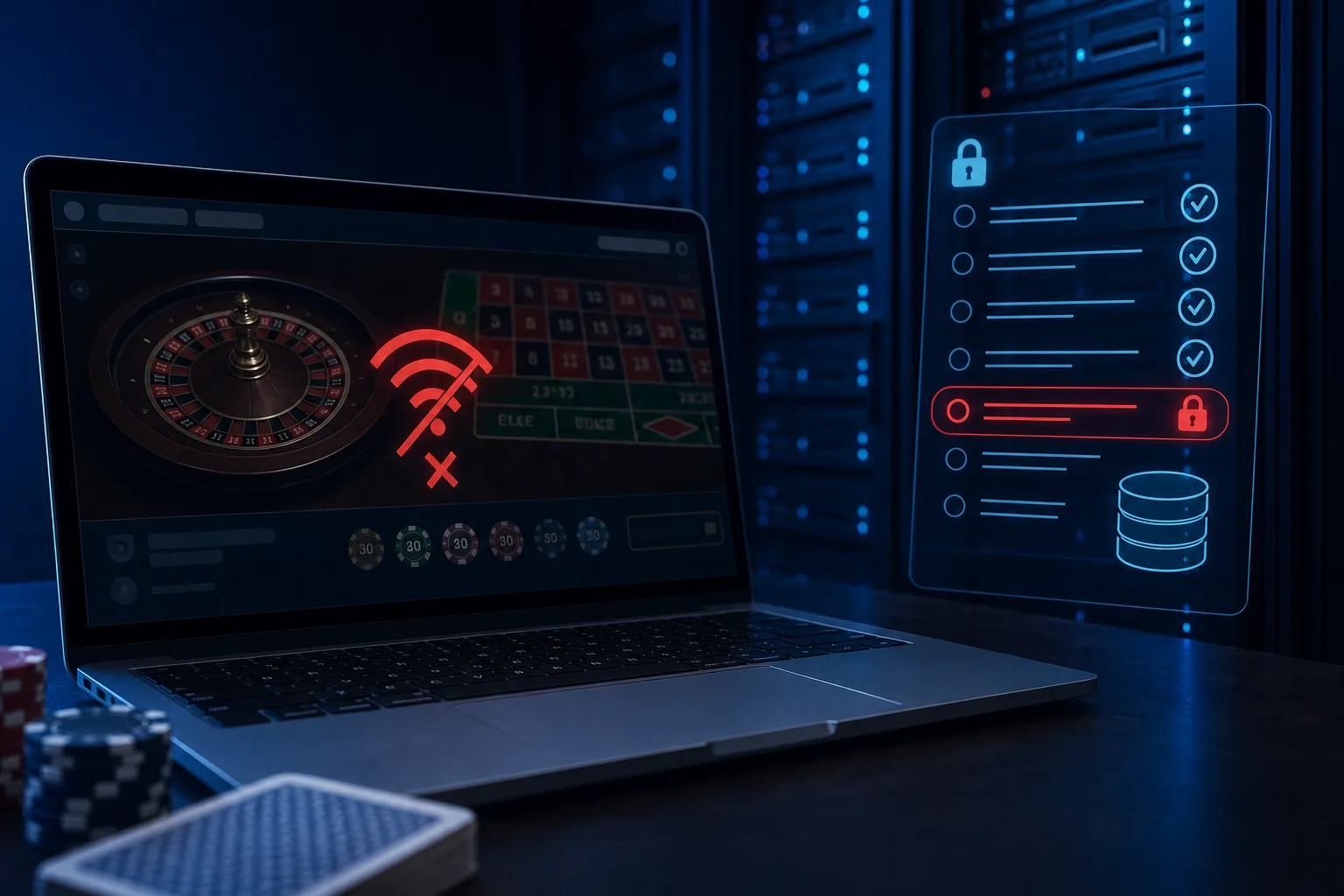
A frozen screen does not necessarily mean that an online casino wager disappeared. In many games, the decisive event occurs on the operator’s or supplier’s server before the animation finishes on the player’s device. If the internet connection drops, the recorded round can already have a valid result waiting to be displayed or credited.
The correct handling depends on the game rules, the stage at which communication failed and the technical standards of the jurisdiction. A player should avoid guessing, refreshing repeatedly or placing replacement bets. The safest response is to preserve the round details, check the account ledger and use the operator’s published complaint route if the balance does not reconcile.
The server record usually controls settlement
Online game screens are interfaces to a remote system. When a player confirms a wager, the request travels to a server, which validates the account, accepts or rejects the stake and records the outcome. The visual spin, deal or wheel animation may arrive afterward.
If the server accepted and completed the wager, a local crash generally does not cancel it. Reopening the game may show the completed result, resume a feature or update the balance. If the request never reached acceptance, the stake should remain available or be restored.
The round identifier and transaction ledger provide stronger evidence than memory of the last animation frame.
What counts as an interruption
Interruptions can result from a home connection failure, mobile signal loss, browser crash, device shutdown, casino maintenance, platform failure or supplier error. Location verification can also lapse in a regulated territorial market.
The cause matters less initially than the state of the transaction. Was the wager accepted? Was an outcome generated? Did the game credit the correct prize? Was a multi-stage feature still open? Each question can have a different answer.
Rules should explain how incomplete games are recovered or settled. A general statement that “all malfunctions void play” should not replace a fair, specific process for ordinary disconnections.
Single-action games
A simple slot spin or digital roulette wager often has one acceptance event and one generated outcome. When a connection fails after acceptance, the server can complete the round and store the result. The balance should reflect that outcome even if the animation was never seen.
If failure occurs before acceptance, no wager should be deducted. A temporary display mismatch may resolve when the account reconnects and synchronizes.
Players should check both game history and cashier history because the game wallet and main account can update at different times.
Multi-stage bonuses and unfinished decisions
Free-spin features, pick bonuses and table games with player decisions are more complicated. The rules may preserve the state so the player can resume. If resumption is impossible, predetermined or optimal choices may be applied, or the feature may settle under a documented fallback.
An operator should not invent a disadvantageous outcome after the event. The recovery method should be built into tested rules. The player-facing help material should explain what happens when a decision is not received within a time limit.
For live dealer games, a video interruption does not necessarily stop the physical round. Accepted wagers can be settled from the recorded table outcome.
Progressive jackpots
A jackpot indication can be especially sensitive. The server and jackpot system determine whether the qualifying event occurred and whether eligibility conditions were met. A celebratory graphic alone is not final proof, but a lost animation should not erase a valid server-recorded trigger.
Save the game name, jackpot name, wager amount, timestamp, screenshot and round ID. Do not continue playing in an attempt to recreate the event. The operator and supplier may need to review logs, game version and jackpot records.
Published rules should cover simultaneous claims, communication faults and verification of large prizes.
Regulatory expectations
The UK Gambling Commission’s remote technical standards require gambling systems to deal with interrupted gambling fairly. Systems should recover from failures and make information available about what happens when play is interrupted.
The precise requirement depends on game type. The principle is that technical failure should not allow arbitrary settlement. Outcomes, stakes and balances must follow approved rules, and records should allow disputes to be investigated.
Other regulators impose their own controls. Use the rules applicable to the licence covering the exact casino domain and player location.
What to do immediately
Stop placing new wagers until the balance is clear. Note the date and exact local time, game title, provider, stake, displayed balance and error text. Capture the round ID or session ID if visible. Take screenshots without exposing passwords or full payment details.
Reconnect through the official site or app, then review game and transaction history. Allow a reasonable synchronization period stated by the operator. Do not reinstall software or clear data until identifiers are saved.
If money is missing or a feature cannot resume, contact support through the verified channel and request a written case number.
How to describe the dispute
A concise report is easier to investigate: “At 20:14 local time, game X deducted a $2 stake under round ID Y. The connection failed after acceptance. History shows no result and the balance is $2 lower.” Attach relevant evidence and ask whether the wager was accepted, voided or settled.
Avoid claiming a specific win unless the record supports it. Ask for the server log, settlement rule and balance adjustment. If support states that a malfunction occurred, request the rule and technical event that justify the resolution.
Keep all messages. A chat transcript can disappear after the window closes.
Escalation routes
Use the casino’s formal complaint process if first-line support does not resolve the issue. The operator should provide response stages and identify any approved alternative dispute resolution service. A regulator may accept reports about systemic failures even when it does not decide every individual payment dispute.
Do not send documents to an “account recovery” service found in unsolicited messages. Verify every escalation link through the regulator’s official website.
For a material claim, local legal advice may be appropriate, particularly when the operator is outside the player’s jurisdiction.
Preventing avoidable interruptions
Use an updated device and verified app or browser, a stable private connection and sufficient battery power. Avoid switching networks during a round. In location-controlled markets, keep required permissions and Wi-Fi enabled.
These steps reduce local failures but cannot prevent server outages. They also do not shift responsibility for correct settlement from the licensed operator.
Set a session limit and avoid rapid repeat clicks when a game appears slow. Duplicate inputs can create confusion about which wagers were accepted.
The key distinction
An interrupted display is not the same as an interrupted wager. The server may have completed the result before the screen failed, or it may have rejected the transaction before any outcome existed. Records determine which occurred.
Pause, preserve identifiers and reconcile the ledger before continuing. A fair system should be able to show whether the bet was accepted and apply the published recovery rule without using a connection problem to create an arbitrary loss.